Did you know… Alaska uses geothermal energy to produce electricity? It might seem highly unlikely...
Other Resources
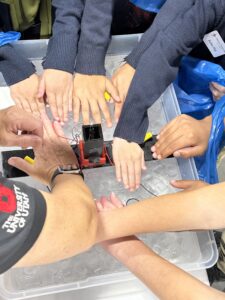
Fun with Geothermal
Categories
Jul 28, 2021
Did you know… Alaska uses geothermal energy to produce electricity? It might seem highly unlikely...

Jul 9, 2021
At the Core – July 2021 Keep up to date on what is going on at Utah FORGE. Read about it in the...
Jun 30, 2021
Did you know... there is a geyser on one of Saturn's moons? And not just one, but over 100 huge...
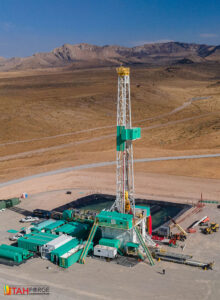
The Utah FORGE project made a number of important advances in 2019 in preparation for the start of deep drilling in 2020. Instrumentation for seismic monitoring was enhanced with the drilling of two new vertical holes, 68-32 (1000’ deep) and 78-32 (3200’ depth), which house permanently installed downhole geophones (68-32) and a distributed acoustic sensing cable (78-32). The new downhole seismic monitoring was augmented with the temporary installation of a Schlumberger multi-level geophone string in 78-32, plus surface deployment of a high-density nodal array. All of this high-resolution seismic monitoring was put in place for stimulation experiments in well 58-32 that were run over a two and a half week period in late April.
Key outcomes of the stimulation include verification that the existing reservoir fracture network can be activated to transmit injected water. The work showed that there were multiple favorable intervals for stimulation in the well, including behind perforated casing. Microseismic events down to -2 magnitude tracked fluid flow in the stimulated intervals, proving the detection sensitivity of the seismic monitoring network. The resulting large data sets were processed and modeled using state of the art computer processing to understand the interplay of fracture dilation and fluid flow in the crystalline reservoir rock. A synthesis of this work is described in the Phase 2C topical report available from GDR.
Other notable outcomes in 2019 include improved understanding of geoscientific attributes. The Mineral Mountains West fault system was shown to terminate south of the Utah FORGE site. A flow test during the drilling of the shallow part of 78-32 proved adequate supply of non-potable groundwater for future needs. InSAR surveys indicate there was no induced ground deformation. Much of the research findings obtained from 2015 to 2018 were published by the Utah Geological Survey in an open access bulletin (UGS MP 169) entitled “Geothermal Characteristics of the Roosevelt Hot Springs System and Adjacent FORGE EGS site, Milford, Utah”, comprising 14 separate chapters.
Jan 2, 2019
Participate in the 2019 Geothermal Data Visualization Design Challenge!
Dec 13, 2018
Several of the Utah FORGE team members attend the 2018 American Geophysical Union Meeting (AGU) in December.
Advancing innovative technologies to unlock Earth’s limitless geothermal energy.


