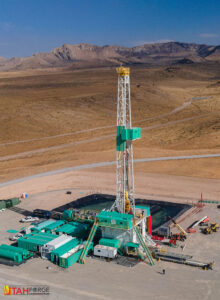
Paper by Peter Niemz et al., (Geothermics) describes seismic observations from the circulation tests at FORGE using only the regional (near-)surface network of the UUSS.


Other Resources
Fun with Geothermal
Categories
Paper by Peter Niemz et al., (Geothermics) describes seismic observations from the circulation tests at FORGE using only the regional (near-)surface network of the UUSS.

On November 11, 2023, the Natural History Museum of Utah (NHMU) showcased its newest permanent exhibit: “A Climate of Hope.”

Known as the volcano snail, iron snail or scaly-foot snail — is a species of snail that lives in hydrothermal vents …
Let’s Connect


For project, contracts and operations, contact Joseph Moore:
utahforge@utah.edu
For Modeling and Simulation Forum information:
utahforge-modeling@utah.edu
For general information, outreach activities and communications:
utahforge-info@utah.edu
For information regarding Solicitations and funding opportunities:
utahforgesolicitations@utah.edu
University of Utah
Energy & Geoscience Institute
423 Wakara Way, Suite 300
Salt Lake City, UT 84108
Phone: (801) 581-5126



The U.S. Department of Energy (DOE) Geothermal Technologies Office (GTO), in partnership with the Frontier Observatory for Research in Geothermal Energy (FORGE) and the Idaho National Laboratory (INL), invites both high school and university (undergraduate & graduate) teams to explore the future of geothermal energy and visualize the world of geothermal energy by participating in the 2019 Geothermal Design Challenge™.
Teams of 2 or 3 members will research data, interpret information and create a data visualization portfolio that will tell a compelling story about geothermal energy.
DID YOU KNOW . . .?
• Energy sources originating from beneath the Earth’s surface satisfy over 80% of total U.S. energy needs.
• Geothermal is one area of sub-surface energy that produces near-carbon-free energy.
• Geothermal has the smallest environmental footprint of all renewable energy sources.
SCENARIO
As a member of the FORGE project team you are tasked with siting a new geothermal well that will help researchers better understand man-made geothermal systems. Using the data provided, recommend an ideal subsurface location to create a sustainable subsurface heat exchanger. This critical step in FORGE’s site development will be the foundation of future R&D and operational efforts at the initiative.
GOAL
Using the data provided, recommend a location within the FORGE footprint where we can create an enhanced geothermal reservoir with minimal environmental consequences. The location must be in granite (granitoid) and be between 175º and 225º Celsius.
• Use a combination of the data (at least 5) to gain an understanding of the site.
• Use the understanding you develop and the data to create 5-10 graphics to communicate your recommended location
CHALLENGE QUESTION
Where do you target your next production well to maximize geothermal reservoir performance?
There are standard methodologies to cite geothermal wells, such as geological interpretation, geospatial analysis, etc. However other methods may offer opportunities and promise like advanced data analytics and machine learning. This data visualization challenge could provide opportunities that haven’t been explored yet.
What is needed . . .?
• A portfolio of data visualizations to support your case (5 minimum / 10 maximum)
• A maximum 1-page write up to explain your visualizations
GUIDELINES
Each visualization should. . .
• Support a single, consistent location of a new production well (Location must be in granite (granitoid) and be between 175º and 225º degrees Celsius.);
• Incorporate at least 2 of the data sets;
• Include data analysis as part of that incorporation;
• Be visually appealing and clean;
• Not be a direct output from a model or software package.
Each portfolio should. . .
• Support a single location of a new production well (Location must be in granite (granitoid) and be between 175º and 225º Celsius.);
• Contain at least 5 unique visualizations, and no more than 10 maximum;
• Visually represent the data sets in the visualizations;
• Have a cohesive visual theme;
• Clearly communicate the location of your proposed well and why it should be there, with minimal words and accompanying text.
• Should have a 1-page maximum accompanying summary.
But I don’t know anything about geothermal energy, or subsurface data. How could I possibly participate?
We are looking for unique perspectives. In other words, your lack of experience with this data is what we’re looking for and is a strength in this competition.
If you have any questions about the data or about geothermal energy and reservoirs, please reach out to the Challenge Team at Geothermalchallenge@inl.gov. In the meantime, take a look at the Resources below!
Eligibility
High school (9-12) and university (both undergraduate and graduate) students (full or part-time) enrolled at an accredited U.S. academic institution at the time of submission are eligible to participate. Only U.S. citizens are eligible to participate in the 2019 Geothermal Design Challenge™.
Teaming
Students are asked to form teams of no more than three members. All members must be eligible to participate in the same bracket (high school or university). Students are encouraged to find a team mentor.
Registration
You must register your team at Skild. Skild coordinates submissions and communication throughout the competition.
Software
Teams can utilize any data visualization software they choose, or a variety of software (public or private license). Some examples are:
• Tableau
• ArcGIS
• Python
• SAS
• R
• Excel
• Octave
• Earth Model Packages (e.g. Leapfrog, Petrel, Jewel Suite, etc.)
You are not limited to only the above software examples.
Timeline
• Registration: beginning January 7, 2019 (8 am ET)
• Submit portfolios: April 10, 2019 (10 pm ET)
• Winners announced: April 24, 2019.
Prizes
The top 3 winning teams will be awarded as follows: $5,000 for 1st place team / $3,500 for 2nd place team / $2,500 for 3rd place team.
Review criteria
Teams will be judged based on the following criteria:
Creativity and innovation – Unique product, compelling to a broad audience, impact; such as utilizing standard geothermal data sets in non-traditional ways or using non-standard data sets in any type of analysis (25%)
Analytical Depth – Logical, clear analysis with a range of complexity; such as using multivariate analysis or machine learning methods; geological reasonableness including what and how many features were used to select the location (25%)
Design – Aesthetics, suitable design elements (25%)
Communication – Clear story, answers the challenge theme; use of visualizations with minimal text; clear narrative to supplement visualizations (25%)
WHAT IS FORGE?
FORGE’s mission is to enable cutting-edge research and drilling and technology testing, as well as to allow scientists to identify a replicable, commercial pathway to EGS. In addition to the site itself, the FORGE effort will include a robust instrumentation, data collection, and data dissemination component to capture and share data and activities occurring at FORGE in real time. The innovative research, coupled with an equally-innovative collaboration and management platform, is truly a first of its-kind endeavor.
R&D Activities
All R&D activities at FORGE will focus on strengthening our understanding of the key mechanisms controlling EGS success–specifically, how to initiate and sustain fracture networks in basement rock formations. This critical knowledge will be used to design and test a methodology for developing large-scale, economically sustainable heat exchange systems, paving the way for a rigorous and reproducible approach that will reduce industry development risk and facilitate EGS commercialization. R&D activities may include, but are not limited to, innovative drilling techniques, reservoir stimulation techniques and well connectivity and flow-testing efforts. The site will also require continuous monitoring of geophysical and geochemical signals.
Additionally, dynamic reservoir models will play an integral role in FORGE by allowing the site operator to synthesize, predict, and verify reservoir properties and performance. R&D activities will have open participation, via competitive solicitations to the broader scientific and engineering community.
As advancements in EGS are made over the course of FORGE’s operation, R&D priorities are likely to shift and change in response. As a result, FORGE will be a dynamic, flexible effort that can adjust to and accommodate the newest and most compelling challenges in the energy frontier!
LEARN MORE
• FORGE
• Top 10 Things You Didn’t Know about Enhanced Geothermal Systems
Guides
Webinars
Geothermal
Data Visualization
1. Who is eligible to participate in the 2019 Geothermal Design Challenge™?
High school and university (both undergraduate and graduate students) students can participate in the challenge. Only U.S. citizens are eligible to participate in the 2019 Geothermal Design Challenge™.
2. How are the teams typically formed?
Students are encouraged to self-select teams of two to three members. A strong foundation in data analytics, subsurface science, and data visualization techniques are ingredients but not required.
3. Is a team sponsor or mentor necessary?
No. But, a mentor is strongly encouraged.
4. What prizes are offered?
The top 3 winning teams will be awarded as follows: $5,000 for 1st place team / $3,500 for 2nd place team / $2,500 for 3rd place team.
5. How will entries be judged?
Entries will be judged according to established merit review criteria:
• Creativity and innovation – Unique product, compelling to a broad audience, impact; such as utilizing standard geothermal data sets in non-traditional ways or using non-standard data sets in any type of analysis (25%)
• Analytical Depth – Logical, clear analysis with a range of complexity; such as using multivariate analysis or machine learning methods; geological reasonableness including what and how many features were used to select the location (25%)
• Design – Aesthetics, suitable design elements (25%)
• Communication – Clear story, answers the challenge theme; use of visualizations with minimal text; clear narrative to supplement visualizations (25%)
6. When does the challenge start?
The challenge opens January 7, 2019.
7. When are submissions due?
April 10, 2019
8. How is the challenge structured?
• Register your team on Skild staring on January 7, 2019.
• Research geothermal and EGS. Analyze the provided data sets, and generate a proposed location of the next production well.
• Create 5-10 visualizations to support the proposed location with minimal text.
• Submit your portfolio, comprised of 5-10 visualizations, along with a 1-page summary, by April 10, 2019.
9. When will winners be notified?
Winners will be notified by April 24, 2019.
10. What are the contest rules?
• Each submission must be submitted by the deadline stated on the website.
• Data visualizations must exclude personal identifiable information (e.g., names, emails).
• Each portfolio should contain a consistent file type, and should be one of the following: PDF, TIFF, JPG, PNG.
• Each visualization must include a list of all data used. Sources should be referenced as footnotes at the bottom of the visualization.
• Each submission must be the contestants’ original work and must not plagiarize, infringe, misappropriate, or otherwise violate any intellectual property rights, privacy rights, or any other rights of any person or entity.
• Data visualizations must be suitable for general audiences (i.e., contain no explicit language, crude/suggestive humor, drug innuendo, or mature/suggestive themes).
• Each team may only submit one portfolio comprised of 5-10 visualizations.
• Data visualizations may not endorse a particular company or entity, nor display a trademarked product, without the explicit permission of the DOE.
• Contestants will not have the right to mark technical data in submissions as “Confidential” or “Proprietary” because the Government has unlimited rights in the data being provided to contestants. DOE does not anticipate that technical data will be generated by contestants.
• Each contestant grants to the Government permission to use and make publicly available any site proposal provided or disclosed to DOE in connection with the competition.
• Each contestant grants to the Government, and others acting on its behalf, a paid-up nonexclusive, irrevocable, worldwide license to reproduce, prepare derivative works, distribute copies to the public, and perform publicly and display publicly, by or on behalf of the U.S. Government, for any and all copyrighted works that are or make up any submission.
• Failing to meet submission requirements or other submission screenings will result in a submission being deemed disqualified.
• 2019 Geothermal Design Challenge and any associated nicknames and logos (“Competition Marks”) are trademarks owned by DOE. The trademark license granted to contestants is below. Non-contestants can request individualized trademark licenses (for the purpose of engaging with contestants and/or expressing interest in the competition); the decision to grant such licenses is under the sole discretion of DOE.
• Contestants are granted, for the duration of the Competition, a revocable, non-exclusive, royalty-free license to use the Competition Marks for the purposes of producing materials for the competition and other approved competition-related activities as long as the use does not suggest or imply endorsement of the contestant by DOE, and the use of the Competition Marks by a contestant does not imply the endorsement, recommendation, or favoring of the contestant by DOE.
• Contestants may not use the Competition Marks for any other purpose. Contestants may not sublicense the Competition Marks.
• All contestants can request individualized trademark licenses; the decision to grant such requests is under the sole discretion of DOE.
11. How can I help promote the contest?
Our digital toolkit has everything you need to help promote the contest.
[/bs_citem]Question: I wanted to ask about the eligibility requirement, it says on the website that only U.S. citizens are eligible to participate. Does that mean that all team members need to be U.S. citizens or is it sufficient to have one U.S. citizen on the team?
Answer: All team participants (registrants) need to be U.S. citizens in order for the team to be eligible.
Question: My team (of two) have made progress processing the various geospatial layers (well locations, well depths, 175 C surface, 225 C surface, granite surface, etc.) additionally we have found some supporting datasets that might provide additional context on site location (distance to transmission lines, environmental concerns, cost surface based on ‘Well Cost Lite’ estimate, etc.). However, neither of us are geothermal experts and we are having challenges interpreting 58-32 well log data. From the eight .csv files how do these readings relate to hydrothermal site optimization? I’ve read through the ‘well_log_README’, some of the Schlumberger ‘Log Interpretation Principal’ book but I can’t piece together how these readings tell us suitability for EGS location. My thought was that we could use the 58-32 well logs to identify vertical depths/locations where fracturing has potential, and perhaps select a porisitiy threshold to reduce subterrain water absorption (which I think would mean drop in flow). Any tips on reading and interpreting these files (e.g. highlighting specific features that could be useful) that we could use to optimize our depth selection would be greatly appreciated.
Answer: Borehole geophysics and log interpretation is a highly specialized field, one can dive “deep” (sorry for the pun) into these data with enough time and experience. Given the very general nature of your question, we really can’t provide much feedback without mentoring you…..something we can’t do and remain impartial. I recommend reach out to a faculty member or teacher.
Question: In well_location_from_earth_model.csv is the column z (land surface) the location of the well top with respect to sea level? That is well top 13-10 is 1796.263 m above sea level and has a depth of 1601.3 from that point?
Answer: Yes.
Question: In well_based_temperature.csv why is some of the depth (z) measurements negative? What is the difference between positive and negative depth?
Answer: The spatial data give the location where the temperature was estimated or measured. “z” is not depth, it is elevation.
Question: What could the core pictures possibly be used for?
Answer: It depends on what other data you have—-if we restrict ourselves to only consider core “pictures” in general we could look for fractures, grain sizes and types, general character of the rock, etc. We can also use the core photos to help with corroborating some of the geophysical well logs.
Question: In choosing the next location, do you mean the next location for an injection-production pair?
Answer: Good Question. We were a bit vague (intentionally) around this topic to allow participants to be creative, and take their project are far as they wanted. I would say that you do not need to propose a well pair, but going through the thought process of planning out an injector-producer pair would be a benefit to your learning experience for sure, and you would not be penalized for doing so in the judging of your submission.
Question: Will these be horizontal wells?
Answer: They could be, but that is up to you to recommend.
Question: Should the wellbores be connected?
Answer: There has to be a hydraulic connection between the well bores that can function to provide sustained recovery of heat from the rocks.
Question: Is the injection well the only well to be fracked?
Answer: Not necessarily, the injection well will definitely be stimulated however.
Question: Do I have to decided how far apart the injection and production wells should be?
Answer: Yes, you make the recommendation.
Question: Is it possible to have access for some examples of projects presented last year?
Answer: This is the first year for running a data visualization contest. We do not have any examples for you to reference. Please refer to the reference materials in the “Resources” section on the website – https://utahforge.com/studentcomp/
Question: It is a suggestion to have a mentor, he or she should be part of FORGE of he can be a professor o Ph.D. student related to geothermal projects?
Answer: Teams are encouraged to use a mentor. Mentors do not need to be part of the FORGE team. Your mentor can be any person you deem appropriate to help you with this project.
Question: What depth is the FORGE research team willing to drill to get the required temperature?
Answer: Temperature isotherms were provided for 175 to 225 degrees C. By and large, we plan to stay within those depths.
Question: Is Colorado a viable option within the forge footprint?
Answer: The FORGE site is in Utah, NOT Colorado.
Question: Where can we find out about other projects like this?
Answer: This is the first project like this sponsored by the Geothermal Technologies Office. However, you can find other competitions sponsored by DoE-Office of Energy Efficiency & Renewable Energy here: https://www.energy.gov/eere/education/competitions.
Question: My group is having trouble figuring out the well survey from earth data sheet. Is azimuth the same thing as strike? Also if azimuth is strike, how can it vary so much at the beginning of the 58-32 well?
Answer: The “dip” is essentially the deviation in the well path from vertical, “90” for the dip means the well is going straight down, a “0” would mean the well is horizontal. The azimuth is the direction the well is dipping, going from 0 to 360 degrees in a clockwise direction. As an example, if the dip is “0”, then a azimuth also has to be “0”, because the well is going straight down. Another example–If part of a well is horizontal and going east, the dip would be 90 and the azimuth would also be 90. Get more information on this page: http://help.leapfrog3d.com/Geothermal/3.5/en-GB/Content/drillholes/desurveying-options.htm
Question: I’m currently working on my 3D modeling of the data. Some of the fault vectors are above ground. Are the xyz values for the temperature surfaces and the faults in feet? I tried converting my DEM from meters to feet, but that distorted the slope proportions. I’m hoping you can give me direction related to the units or other information about the z values of the faults and the temperature data so that I can accurately represent their position below ground.
Additionally, I am using a DEM that I downloaded off of National Map Viewer because it allows me to do a bit more than the land surface data file provided. I just wanted to clear that with you since it is outside the provided data. I’ll be sure to cite my source of the data in the project.
Whether I use my DEM or the land surface provided, along with the FORGE outline shape file, they all seem too deep in the Earth relative to the faults and thermal surfaces.
Answer: 1. Regarding faults, yes, they do go above the ground surface. They can be cropped to the ground surface as needed. 2. X,y,z data are all in meters. 3. The FORGE shapefile is just set to an arbitrary elevation. The important part is the x,y coordinates.
Question: I am an undergraduate student at the University of Utah who is interested in participating in this challenge. However, I am also a research student employed under the Energy & Geoscience Institute. From my understanding, FORGE and EGI have a relation to one another. Because of this, am I unqualified to participate?
Answer: You are eligible to participate in the 2019 Geothermal Design Challenge™. However, please do not reach out to EGI staff with questions. All questions must be sent to Geothermalchallenge@inl.gov for consideration.
Question: Should we be considering financial and legal limitations for our proposed well site and incorporate these analyses into our project, or can these factors be ignored?
Answer: For the most part, please focus on the technical aspects and think about the art of the possible, be creative! But, having said that, if you propose something very out of the ordinary as part of your work, having some information on feasibility (for both coat and permitting) might be good information to include.
Question: Do we need to consider current well conditions in our analysis? i.e. casing condition, grouting, etc. or should we assume all wells are in usable condition and could function as production or injection wells as needed?
Answer: You can assume the current text well (58-32), and any other well you proposal or stipulate, are fully usable to within industry standard pressures one might expect during stimulation activities.
Question: Is there well connectivity/tracer data? we couldn’t find it among the many files.
Answer: No, we haven’t conducted any tracer tests yet. Some are planned for this summer, but it will be after the contest is concluded.
Question: What EGS stimulation conditions should we assume are available for our proposed production well? i.e. what fracture length and density should we consider reasonable?
Answer: That is for you to answer!! Reasonable is a relative term, based on your analysis and thoughts, you should be able to communicate why the outcome of your project is reasonable.
Question: In the online description FORGE says that participants should use a choice of software packages to create “visualizations”, but then there is the statement that the visualizations should “Not be a direct output from a model or software package”. How do participants create visualizations using software without the output coming from the model or software package? Do you have any examples of past “visualizations” you can provide to clarify what is expected?
Answer: Excellent question! The statement means we don’t just want a bar chart or line graph but rather we would like a dashboard or portfolio of visualizations to tell a story. Some of the best examples can be found at https://public.tableau.com/en-us/s/gallery. Specifically, notice how Boeing uses multiple visualizations to tell a story about their global market (https://public.tableau.com/en-us/s/gallery/boeing-current-market-outlook?gallery=featured).
Question: Can we use a mentor? Are High School teachers or scientists at local companies okay? Do they need to register with FORGE?
Answer: Yes. Having a team mentor is encouraged. Mentors do not need to register.
Question: Are we limited to only the “student” data sets provided in the links provided by FORGE, or can we use other data sets at the FORGE website, or elsewhere?
Answer: You are more than welcome to use other data, but it must be publicly available and you must cite any outside data used at the time of submission. Please remember that the challenge focuses on siting a new well at the FORGE site in Milford, UT. However, please send us the data link (Geothermalchallenge@inl.gov) you plan to use as soon as possible. We would like to vet it accuracy.
Question: Are we allowed or encouraged to find published articles re the FORGE site?
Answer: Yes, you are encouraged to find articles about FORGE.
Question: Where can I find a key for the geologic map of the FORGE site and the descriptions of the different colored rock types?
Answer: This link has the full geologic map, with a legend: https://gdr.openei.org/submissions/1034
Question: Are the Unity Game Engine or Three.js JavaScript library available to use when creating our visualization?
Answer: These two frameworks are open-source but we haven’t developed any special visualization libraries in either for this competition. You are free to use any software to build your visualizations, just be sure to follow the guidelines. https://utahforge.com/studentcomp/
As a follow-up to this response, these two frameworks are open-source but we haven’t developed any special visualization libraries in either for this competition.
Question: Are we limited to using the data provided?
Answer: You are more than welcome to use other data, but it must be publicly available and you must cite any outside data used at the time of submission. Please remember that the challenge focuses on siting a new well at the FORGE site in Milford, UT.
Question: In regards to the Geothermal Design Challenge 2019-Data Visualization, can students from universities outside the USA submit for this competition?
Answer: Students who are U.S. citizens and who are attending accredited U.S. universities at the time of the competition are welcome to participate in the challenge.