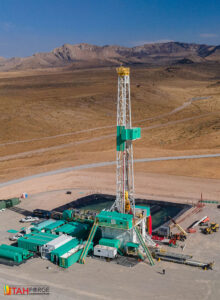

Utah FORGE is excited to announce the successful completion of the three-stage hydraulic...



A term borrowed from studies of hydrothermal ore deposits that refers to an assemblage of secondary hydrothermal minerals which forms in igneous rocks. This assemblage is made up of chlorite, illite, feldspar (both Na and K-rich varieties), epidote, calcite and pyrite, imparting a dark green tint to the appearance of altered rocks. It is commonly developed in volcanic-plutonic sequences that host high-temperature geothermal reservoirs.

Magma Molten rock typically having a temperature between 800° and 1100° C (~1500-2000° F). Magma is the source of high-grade geothermal energy in conventional resources.

Magnetotelluric (MT) Geophysical Method Makes use of naturally occurring electromagnetic waves to image the resistivity structure of the subsurface. The results can reveal the locations of hot geothermal fluids, blankets of clay alteration, and highly saline water. MT...

Microseismicity Tiny earthquakes that result from slip or shear along a fracture caused by an uneven distribution of stress. The displacements are very small scale and unfelt at the surface. They can only be detected with sensitive equipment such as geophones and...


