Did You Know…

This Country is Championing its Hidden Geothermal Potential?

When you think of countries that use geothermal energy, you may think of the United States, Indonesia, New Zealand, or even Iceland and Turkiye. But in the active continental rift zone of East Africa, Kenya produces the most electricity from geothermal energy per capita of any country in the world!

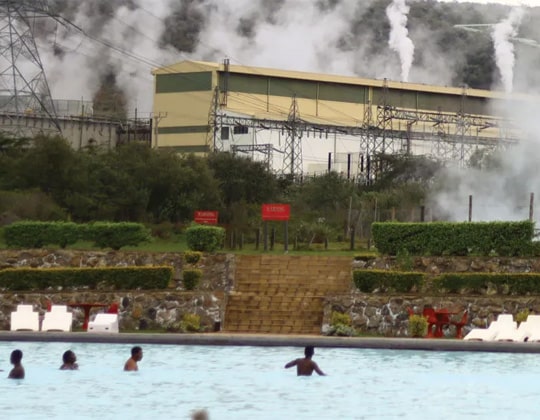
People relax in a geothermal pool at a commercial spa located next to the Olkaria geothermal power plant in Kenya, illustrating the direct use of geothermal heat alongside electricity generation.

Olkari geothermal power project is directly adjacent to a commercial spa. Source: Kamadi, G., ScienceNews.

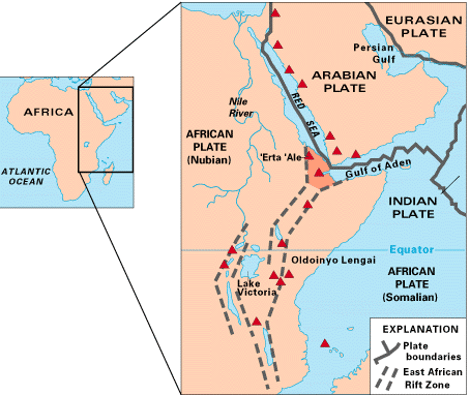
Map of East Africa highlighting historically active volcanoes marked by red triangles and the Afar Triangle region, illustrating tectonic activity associated with the East African Rift System.

Map of East Africa showing some of the historically active volcanoes (red triangles) and the Afar Triangle. Source – USGS

Kenya’s Geological Region

The Northeastern part of Africa is a developing divergent plate boundary called the East African Rift System. This is where the Somalian plate (home to Kenya and several other East African countries), the Nubian plate, and the Arabian plate (home to Saudi Arabia, Yemen, Qatar, and other countries in Southwest Asia) are extending from each other. This area is rich in molten rock and geothermal energy. The 2025 Hayli Gubbi eruption in Ethiopia and “Fani Maoré” eruptions on the island of Mayotte from 2018-2021 show that this region is quite geothermally active. At the center of this tectonic activity, “Kenya is well endowed with high temperature geothermal resources that are largely untapped.” (Mangi, 2017, p. 1)

Direct Uses

While much of Kenya’s geothermal potential is not yet realized, the heat of the earth is directly used throughout the country because shallow heat is easily accessible. Direct use has been documented since the early 19th century, when the Enderois people used the strong odor of hot springs for ceremonial traditions to appease their ancestors who drowned when Lake Bogoria was formed. Now the local hot springs are points of interest for tourists seeking adventure around Mount Kilimanjaro.

The Eburru geothermal drying system was used in the 1940s to dry pyrethrum flowers and maize; a pipe leak cooled down the drier while providing Eburru residents the ability to condense some geothermal steam from nearby fumaroles into drinking water.

In Olkaria, over 30MWt is used for heating flower farms and spas. Other greenhouses use geothermal CO2 required for photosynthesis, sterilize fertilized water, and keep the greenhouses at a steady temperature and humidity level.

The benefits of geothermal power don’t stop there. Near the Menengai Crater, a variety of direct-use demonstration projects show how by-products from pilot power plants can benefit local communities through their use in milk pasteurization, meat processing, fish farming, and even laundry units. Additionally, the extraction of by-products from geothermal liquids could prove profitable by using lithium and silica  to make batteries and glass.

Geothermal Energy in Kenya

43%

Of Kenya’s Electricity From
Geothermal Energy (2024)

#1

Globally Per Capita
Geothermal Electricity

400°

Estimated Geothermal
Reservoir Temperatures (°F)

3X

Estimated Geothermal
Potential vs. Installed Capacity

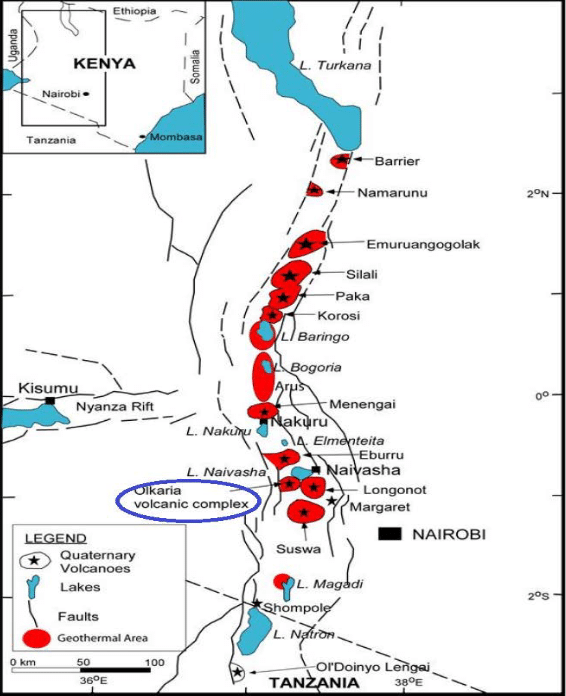
Map of Kenya showing major geothermal areas along the East African Rift, including Olkaria, Menengai, Eburru, and other geothermal fields associated with volcanic complexes and fault zones.

Source – Mangi, P. M. (2017). Figure 1.

Electricity

While geothermal prospecting began in the 1890s, the first power plant was not commissioned until 1981. Geothermal power was seen as undesirable for many years because hydropower was more abundant and cheaper. However, in the 1960s-1970s, geoscientific research was incentivized by the world oil crisis; which highlighted the potential of Kenya, specifically within the Olkaria Geothermal Area. Temperatures estimated at almost 400°F paired with highly permeable rock and natural aquifers (Omenda, 1998) have the potential to generate three times more than Kenya’s total current installed electricity capacity (Kamadi, 2023). 

One unique facet of Kenya’s electricity production is collaboration with the sedentary and semi-nomadic Maasai population. In areas where indigenous communities would be affected by geothermal power development, they “are involved, informed and educated about the potential opportunities and risks.” They are active participants in the construction and development of geothermal power plants, receiving compensation, land titles, and critical health infrastructure from both the nation’s government and private companies.

In 1995, geothermal provided just 9.5% of Kenya’s electricity. This has exponentially grown to provide over 43% of the country’s electricity in 2024. The majority of the generation is run by Kenya Electricity Generating Company (KenGen) in Olkaria. Other organizations like Ormat and Africa Geothermal International Limited (AGIL) have developed geothermal power plants. The country boasts the largest percentage share of electricity from geothermal in the world, and it is only increasing.

Beyond its borders, Kenya is spurring momentum for geothermal energy across Africa. Even though 43% of Africa’s population lacks access to electricity, companies from this hot spot are providing technical and economic support to neighboring countries like Ethiopia and Djibouti. While this renewable energy has a higher up-front cost, many believe that it will lead to universal low-cost energy access.
Looking to the Future

Kenya is one of the best examples of geothermal energy in action. Olkaria Geothermal Complex is one of the largest geothermal fields in the world, and the federal research plan aims to advance global geothermal investments. The future of Kenya is framed in Vision 2030, a state-led project that seeks to “transform Kenya into a newly industrializing, middle-income country providing a high quality of life to all its citizens by 2030 in a clean and secure environment.” A key factor of this plan is electricity generation. Geothermal heat is locally available, constant, and scalable to meet the needs of the growing region. It is going to play a key role in this stage of development for the country, as Kenya seeks to almost double its  installed geothermal electricity capacity (p. 8) by 2030.

References

  • Berthod, C., Komorowski, J.-C., Gurioli, L., Médard, E., Bachèlery, P., Besson, P., Verdurme, P., Chevrel, O., Muro, A. D., Peltier, A., Devidal, J.-L., Nowak, S., Thinon, I., Burckel, P., Hidalgo, S., Deplus, C., Loubrieu, B., Pierre, D., Bermell, S., … Lebas, E. (2022). Temporal magmatic evolution of the Fani Maoré submarine eruption 50 km east of Mayotte revealed by in situ sampling and petrological monitoring. Comptes Rendus. Géoscience, 354(S2), 195–223. https://doi.org/10.5802/crgeos.155
  • East African Rift Valley, East Africa. (n.d.). The Geological Society. Retrieved December 16, 2025, from https://www.geolsoc.org.uk/science-and-policy/plate-tectonic-stories/east-african-rift-valley/
  • Kamadi, G. (2023, July 12). How Kenya is helping its neighbors develop geothermal energy. https://www.sciencenews.org/article/geothermal-energy-africa-kenya-renewable-electricity
  • Kenya Energy Announcement of $1.8 billion Geothermal expansion for electricity. (2025, February 10). https://www.trade.gov/market-intelligence/kenya-energy-announcement-18-billion-geothermal-expansion-electricity
  • Kenya is hot for geothermal energy. (2025). KfW Development Bank. https://www.kfw-entwicklungsbank.de/SDG-portal/SDG-7/Geothermal-energy-Kenya/
  • Mangi, P. M. (n.d.). Thermal exploration in Kenya – status report and updates. Presented at SDG Short Course II on Exploration and Development of Geothermal Resources, organized by UNU-GTP, GDC and KenGen, at Lake Bogoria and Lake Naivasha, Kenya, Nov. 9-29, 2017.
  • Mogul, R. (2025, November 25). This volcano erupted for the first time in 10,000 years sending ash clouds across continents. CNN. https://www.cnn.com/2025/11/25/asia/ethiopia-hayli-gubbi-volcano-eruption-india-pakistan-intl-hk
  • Omenda, P. A. (1998). The geology and structural controls of the Olkaria geothermal system, Kenya. Geothermics, 27(1), 55–74. https://doi.org/10.1016/S0375-6505(97)00028-X
  • Rotich, I. K., Chepkirui, H., Musyimi, P. K., & Kipruto, G. (2024). Geothermal energy in Kenya: Evaluating health impacts and environmental challenges. Energy for Sustainable Development, 82, 101522. https://doi.org/10.1016/j.esd.2024.101522
  • Use of geothermal energy. (n.d.). U.S. Energy Information Administration. Retrieved December 16, 2025, from https://www.eia.gov/energyexplained/geothermal/use-of-geothermal-energy.php

Latest Posts

Utah FORGE

Advancing innovative technologies to unlock Earth’s limitless geothermal energy.