Current Activities at Utah FORGEAs part of the Energy & Geoscience Institute's Spring Webinar...


Other Resources
Fun with Geothermal
Categories
Current Activities at Utah FORGEAs part of the Energy & Geoscience Institute's Spring Webinar...

University of Utah and Utah FORGE Complete Contract Negotiations with 9 of 13 Awardees of Solicitation 2022-2 …

Paper by Peter Niemz et al., (Geothermics) describes seismic observations from the circulation tests at FORGE using only the regional (near-)surface network of the UUSS.
Let’s Connect


For project, contracts and operations, contact Joseph Moore:
utahforge@utah.edu
For Modeling and Simulation Forum information:
utahforge-modeling@utah.edu
For general information, outreach activities and communications:
utahforge-info@utah.edu
For information regarding Solicitations and funding opportunities:
utahforgesolicitations@utah.edu
University of Utah
Energy & Geoscience Institute
423 Wakara Way, Suite 300
Salt Lake City, UT 84108
Phone: (801) 581-5126

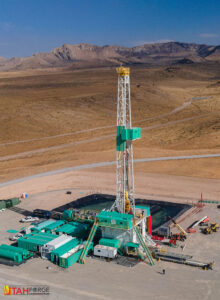
The Utah FORGE project began in 2015 and has produced significant achievements in geology, geophysics, and well engineering. To date there have been seven wells drilled including 58-32, a deep vertical well, 16A(78)-32 (injection) and 16B(78)-32 (production) – two highly deviated deep wells, and 68-32, 78-32, 78-32B, and 56-32 which are deep seismic monitoring wells. Stimulation tests and fracture modeling have been accomplished on 58-32 and 16A(78)-32. Seismicity has been monitored throughout the drilling and testing programs. All data collected during ongoing research at the site and by the R&D recipients are free and publicly available and stored on the Geothermal Data Repository.
Learn more about the Utah FORGE project site.
Explore the Utah FORGE wells. Find general data below, or click on the image markers to learn about each individual well.
Download Utah FORGE general well data.


The University of Utah, in support of the Department of Energy’s (DOE), Energy Efficiency and Renewable Energy (EERE) Geothermal Technologies Office (GTO) Frontier Observatory for Research in Geothermal Energy (FORGE) offers solicitations for advancing Enhanced Geothermal Systems (EGS) technologies.
To learn more about available funding opportunities, click the button below.
View R&D projects (and their data) that are participating in Utah FORGE.
View Utah FORGE geology data.
View Utah FORGE water chemistry and ground water Data.
View Utah FORGE geophysics data.
A robust, three-dimensional earth model incorporating existing/historical data and newly collected geologic information has been developed.
To learn more about the numerical implementation of the conceptual and earth models, click the button below.
View historical and newly collected geologic data.
View detailed data regarding each seismic well.
EGS reservoir monitoring at Utah FORGE is accomplished using seismic instrumentation of deep boreholes.
To learn more about the Utah FORGE seismic monitoring infrastructure, click the button below.
Geospatial data is critical for all types of geothermal exploration. Early in the Utah FORGE project a number of geospatial datasets were produced for planning.
Check out geospatial dataset links and maps.
View reports related to the Utah FORGE Project.
Find more information, reports, and data in the Geothermal Data Repository.
