Current Activities at Utah FORGEAs part of the Energy & Geoscience Institute's Spring Webinar...


Other Resources
Fun with Geothermal
Categories
Current Activities at Utah FORGEAs part of the Energy & Geoscience Institute's Spring Webinar...

University of Utah and Utah FORGE Complete Contract Negotiations with 9 of 13 Awardees of Solicitation 2022-2 …

Paper by Peter Niemz et al., (Geothermics) describes seismic observations from the circulation tests at FORGE using only the regional (near-)surface network of the UUSS.
Let’s Connect


For project, contracts and operations, contact Joseph Moore:
utahforge@utah.edu
For Modeling and Simulation Forum information:
utahforge-modeling@utah.edu
For general information, outreach activities and communications:
utahforge-info@utah.edu
For information regarding Solicitations and funding opportunities:
utahforgesolicitations@utah.edu
University of Utah
Energy & Geoscience Institute
423 Wakara Way, Suite 300
Salt Lake City, UT 84108
Phone: (801) 581-5126

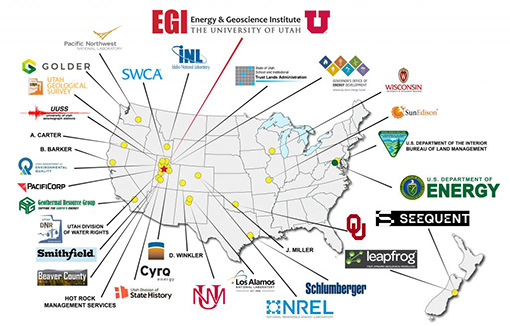
University of Utah’s Energy & Geoscience Institute R&D management team and partners
The Utah FORGE project is part of the University of Utah’s Energy & Geoscience Institute (EGI). The project is committed to creating a national laboratory to accelerate the development of enhanced geothermal system technologies. The research team is comprised of the nation’s best technical and R&D management leadership from the oil and gas and geothermal industries, R&D universities, national laboratories, and energy technology companies. To enhance the capabilities and expand its reach, the project team is supported by a Science and Technology Advisory Team composed of the leading experts in Enhanced Geothermal System development and reservoir stimulation, and the Department of Energy.

Managing PI
Dr. Moore has participated in DOE projects since the mid-1970s and currently holds several appointments at the University of Utah.

Technical Expert on Geology and Geochemistry
Dr. Simmons is a Research Professor at the Energy & Geoscience Institute (EGI) and in the Department of Chemical Engineering.

Lead Reservoir Management
Dr. McLennan holds several appointments at the University of Utah, including Senior Research Scientist at EGI.

Seismic Monitoring Coordinator
Dr. Pankow is an Associate Director of the U of U Seismograph Stations and a Research Professor in the Dept. of Geology & Geophysics.

Technical Expert on Reservoir Modeling
Dr. Podgorney is a senior scientist and department manager with INL and an affiliate faculty member with the Center for Advanced Energy Studies.


The Project Management Team (PMT) at University of Utah’s Energy and Geoscience Institute (EGI) is committed to creating a national laboratory to accelerate the development of enhanced geothermal technologies. EGI’s success will be dependent upon two interrelated factors: the suitability of the Milford site and our management team. The Milford site’s suitability is based on a range of characteristics that will allow for effective testing of EGS R&D concepts from across the nation. The team that we have assembled will create a collaborative platform for EGS R&D. This team is comprised of the nation’s best technical and R&D management leadership from the oil and gas and geothermal industry, R&D universities, national laboratories and energy technology companies. To enhance the capabilities and expand its reach, the EGI team will be supported by a Science and Technology Advisory Team composed of the leading experts in Enhanced Geothermal System development, reservoir stimulation and the DOE.
The Utah FORGE PMT oversees key technical and operational aspects of FORGE and is responsible for managing all financial aspects of the FORGE project. It is responsible for conceptualizing, planning and executing research and testing at the FORGE site through development of an Annual Operating Plan. By the nature of their roles on the TARMaC and R&D SC, members of the Utah FORGE PMT will coordinate with the STAT and GTO.
The STAT is the Science and Technology Analysis Team. The STAT is an integral part of the Frontier Observatory for Research in Geothermal Energy (FORGE). FORGE is envisioned to be an international field laboratory managed by the University of Utah (Utah FORGE) for developing the technologies required for the creation, sustainability and monitoring of Enhanced Geothermal System (EGS) reservoirs.
The STAT shall advise, assist, support and plan research activities for the FORGE program. STAT activities are expected to strengthen the technical rigor and raise scientific research potential of Utah FORGE.
The STAT will consist of up to 15 members and the Chair. The STAT’s primary charge is to provide overall technical guidance throughout Phases 2C and 3, and to ensure that DOE objectives are fully considered and incorporated into the execution of FORGE and associated R&D projects. Members of the STAT will be aligned with key technical areas of FORGE and are envisioned to be thought leaders in their respective fields.
The STAT will:
The STAT will be assisted by an international subcommittee comprised of government officials or technical experts appointed by their nation’s government to serve in an ex officio role. Members of this subcommittee will attend open meetings of the STAT in a non-voting capacity.
The TARMaC will be aligned with key technical areas of FORGE. The TARMaC’s primary responsibilities center on supporting the R&D solicitation development process, coordinating and performing reviews, and serving as technical monitors for external R&D.
The external R&D program will be managed by the Research and Development Steering Committee (R&D SC) working in concert with the Technical Analysis, Review, and Monitoring Committee (TARMaC) and the Science and Technology Analysis Team (STAT).
The Geothermal Technologies Office (GTO) plays a leadership role in developing, planning and funding the FORGE program and external FORGE R&D. The Project Managers will assist in the development of R&D solicitations, ensure all DOE mandated requirements are captured and provide day-to-day support of the selected R&D projects.
Dr. Moore serves on the PMT as the Managing PI. Dr. Moore has participated in DOE projects since the mid-1970s. He holds appointments at the University of Utah as a Research Professor in the Department of Civil and Environmental Engineering and as an Adjunct Professor in the Department of Geology and Geophysics. Dr. Moore currently serves as the Managing PI, with Co-PI Dr. McLennan on the Raft River EGS project “Concept Testing and Development at the successful Raft River Geothermal Field, Idaho”. Dr. Moore has also actively participated in both the Coso and Desert Peak EGS projects. His expertise is in the geology, hydrothermal alteration and geochemistry of geothermal systems and in the development of conceptual models based on geoscientific data. He has published more than 150 reports and articles on his investigations. He serves on the Board of Directors of the Geothermal Resources Council and the Geothermal Energy Association Technical Board.
Dr. Simmons serves as the Technical Expert on Geology and Geochemistry. He is a Research Professor at the Energy & Geoscience Institute (EGI) and in the Department of Chemical Engineering, University of Utah. He uses a wide range of chemical and mineralogical methods to investigate hydrothermal fluid flow, heat transfer, and mineralizing processes in geothermal resources and ore deposits. He has worked extensively in New Zealand, Chile, Mexico, and the western USA. From 1987 to 2008, he was on the academic staff of the Geothermal Institute at the University of Auckland where he served as Associate Professor and Director. Before joining EGI in 2013, he worked as a consultant and was a Research Professor at Colorado School of Mines (2011-2012). His published work appears in American Journal of Science, Economic Geology, Geothermics, Geology, Journal of Geophysical Research, Journal of Volcanology and Geothermal Research, Nature, and Science, and he has given numerous short courses on geothermal resources and epithermal mineralization. He is recipient of the Skinner Award (2012, with J. Rowland), the Silver Medal (2014) and the Marden Award (2018) from the Society of Economic Geologists. He currently serves on technical review panels for the Ngawha, Rotokawa, and Wairakei geothermal projects in New Zealand.
Dr. McLennan serves as a Co-PI on the PMT and as the Technical Lead for Resource Management activities. Since 2009, Professor John McLennan has been a faculty member in the Department of Chemical Engineering at the University of Utah. He has been a Senior Research Scientist at the Energy & Geoscience Institute and an Adjunct Professor in the Department of Civil Engineering at the University of Utah since 2008. He has a Ph.D. in Civil Engineering from the University of Toronto, awarded in 1980. Before joining the university, he had more than thirty-five years of experience with petroleum service and technology companies. He worked nine years for Dowell Schlumberger in their Denver, Tulsa, and Houston facilities. Later, John was with TerraTek in Salt Lake City, Advantek International in Houston, and ASRC Energy Services in Anchorage. He has worked on projects concerned with subsurface energy recovery (hydrocarbon, geothermal) in a variety of reservoir environments throughout the world. He is an ARMA Fellow and has served as ARMA president
Dr. Kristine Pankow serves as the Technical Expert on Seismic Monitoring and Imaging. She is currently the Acting Director of the University of Utah Seismograph Stations (UUSS) and is a Research Professor in the Geology and Geophysics Department. Dr. Pankow is the Advanced National Seismic System, Regional Coordinator for the Intermountain Region, the Board Secretary for the Seismological Society of America, and is a member of the Utah Mine Safety Technical Advisory Council. Dr. Pankow has over 20 years of experience in monitoring and analyzing seismicity and seismotectonics in the eastern Great Basin, including central and western Utah – where the Utah FORGE site is located. She has a well-established research program studying seismic sequences (both natural and induced) within the Great Basin. She and her research group are currently using time and frequency waveform based analysis to extend detection thresholds for microseismicity, exploring algorithms to determine source properties of small earthquakes, and are performing detailed analyses of swarm and triggered seismic sequences to better understand the physical processes that lead to these sequences.
Dr. Robert Podgorney is the Technical Expert on Reservoir Modeling activities at Utah FORGE. Dr. Podgorney serves as the director of the Nuclear Computational Resource Center and a directorate fellow of the advanced scientific computing division at the Idaho National Laboratory, leading a diverse team of scientists and engineers focused on developing computational tools and frameworks for energy related applications. His personal research interests center on energy and water related issues, focusing on investigations of fluid flow, heat transport, and mechanics in fractures and fracture networks and the development of massively parallel simulators for describing these systems. He has a Ph.D in Geology (multiphase fluid flow, computational fluid dynamics) from the University of Idaho, and serves as the Chair for Reservoir Modeling to the International Partnership for Geothermal Technology, a multinational coordination effort focused on advancing geothermal energy.