
The Energy & Geoscience Institute announces Dr. Kristie McLin as Director of Research and Science and new Principal Investigator of the Utah FORGE project, succeeding Dr. Joseph Moore.


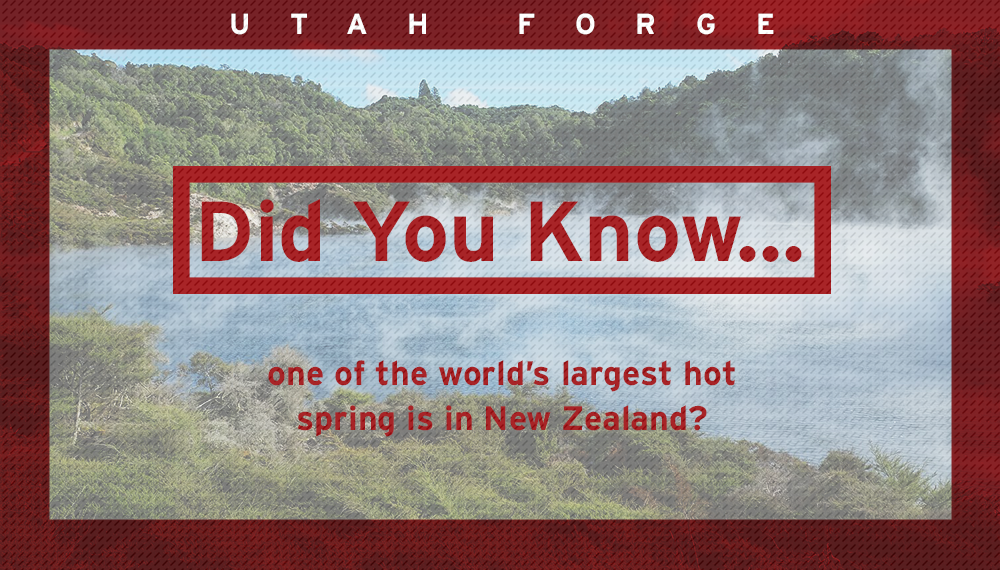
Located in the Waimangu Volcanic Rift Valley near Rotorua, Frying Pan Lake is one of the world’s largest hot springs! It is also one of the youngest, with a precise birthdate of April 3, 1917, having filled and formed in the aftermath of a hydrothermal eruption that lasted three days.
The origin of the lake dates to the early morning hours of June 10, 1886, when Mount Tarawera came to life. This is New Zealand’s deadliest volcanic eruption, even if it was small in size and lasted just a few hours. A line of craters 16 km (~10 mi) long was the result. One, Echo Crater, which hosts Frying Pan Lake, was transformed in the years that followed into a flat-bottomed basin by the erosion-sedimentation of loose ash that blanketed the surrounding hillsides. Because of the steam vents that dotted the basin floor, it became known as Frying Pan Flat.
The hot lake covers an area of 38,000 m2 (~409,030 ft2) and reaches 15 m (45 ft) depth. Swirls of steam rise off the lake surface owing to the inflow of boiling water from four underwater vents. Hot water (50-60˚C; 122-140˚F) overflows the east side of the lake at up to 2000 gallons/minute.
Frying Pan Lake hosts a variety of thermophile organisms, including cyanobacteria and the single-celled archaea. These represent some of the earliest forms of life, making it a modern laboratory for field study of evolution in extreme conditions.
Waimangu is open to tourists. A self-guided nature walk takes one around the edge of Frying Pan Lake. Other amazing sights include the aqua-colored and hot Inferno crater lake, spouting hot springs, silica stalagtites, and Lake Rotomahana, which was the site of the famous Pink and White silica terraces.
https://whenonearth.net/frying-pan-lake-worlds-largest-hot-spring/
https://www.ablison.com/worlds-largest-geothermal-pools-hot-springs-location/
https://www.atlasobscura.com/places/frying-pan-lake
https://www.lakescientist.com/frying-pan-lake-largest-hot-spring/
Kenya may not be the first country that comes to mind when thinking about geothermal energy, but it leads the world in geothermal electricity production per capita. Sitting atop the geologically active East African Rift System, Kenya has tapped into the Earth’s heat for power, agriculture, industry, and community development—transforming a once-overlooked resource into a cornerstone of its energy future.
Spanning more than 45 square miles, The Geysers in northern California is the largest geothermal power plant complex in the world. For over a century, its steam has powered innovation, clean energy, and communities across the region.

Before it became the world’s largest geothermal power-producing site, The Geysers was known as the “Gates to Hades,” drawing visitors with its healing waters, steam vents, and wild legends.