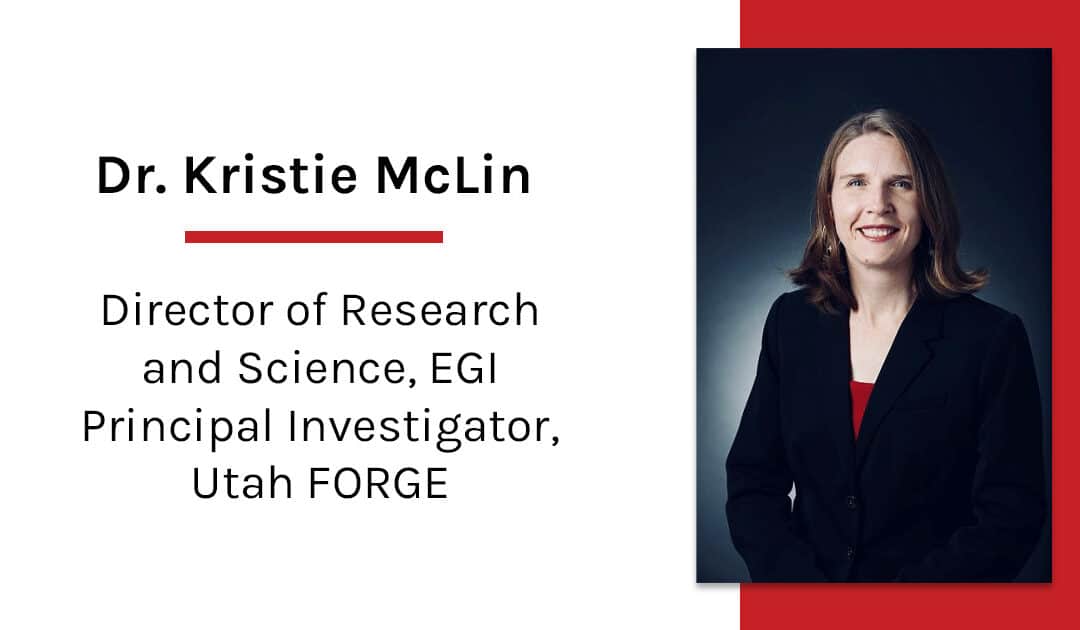
The Energy & Geoscience Institute announces Dr. Kristie McLin as Director of Research and Science and new Principal Investigator of the Utah FORGE project, succeeding Dr. Joseph Moore.

Take a quick tour of the world’s top geothermal energy producers and the new tech making clean energy possible in more places than ever before.
Geothermal energy is a hot rising topic in the world of renewable energy. Countries around the world are looking beneath their feet to increase their megawatt production.
At the end of 2024, together they achieved over 16,873 MW in installed capacity according to ThinkGeoEnergy’s new “Top 10 Geothermal Countries 2024 – Power!“

Cariaga, C. (2025). ThinkGeoEnergy’s Top 10 Geothermal Countries 2024 – Power. ThinkGeoEnergy. Published January 20, 2025. https://www.thinkgeoenergy.com/thinkgeoenergys-top-10-geothermal-countries-2024-power/
The four leading countries for geothermal MW production are the United States, Indonesia, the Philippines, and Türkiye. These countries are geographically positioned in areas where conventional geothermal systems exist naturally.

Optimal geothermal suitability distribution produced by the Maximum Entropy model using all parameters." From: Predicting geographical suitability of geothermal power plants - Scientific Figure on ResearchGate. Availablhttps://www.researchgate.net/figure/Optimal-geothermal-suitability-distribution-produced-by-the-Maximum-Entropy-model-using_fig3_341430409
The International Energy Agency (IEA) explains that conventional geothermal “remains a location-specific, niche technology today” (2024). Areas with very little volcanic or tectonic activity have limited geothermal viability, including a number of Middle Eastern (Qatar, Saudi Arabia, Chad) and Nordic (Sweden, Finland, Denmark) countries. While these regions cannot access conventional geothermal resources, there is still optimism thanks to developing technologies. Dr. Stuart Simmons addresses some of these limitations in his 2020 webinars for electricity generation; he presents on both conventional and unconventional geothermal resources.
One of the several technology breakthroughs in geothermal energy production is Advanced Geothermal Systems (AGS). According to “POWER” Magazine in 2022, artificially created closed-loop circuits transfer heat from sub-surface rocks to an insulated working fluid held in the pipes. This technology has been highlighted because of reduced water consumption, limited induced seismicity, and integration with existing district heating technology. Detractors to this technology note that AGS requires larger well bores, which has the potential to substantially increase the costs of drilling.

Patel, S (2023). EGS, AGS, and Supercritical Geothermal Systems: What’s the Difference? Power Magazine. Published April 4, 2023. https://www.powermag.com/egs-ags-and-supercritical-geothermal-systems-whats-the-difference/

Reinsch, T., Dobson, P., Asanuma, H. et al. Utilizing supercritical geothermal systems: a review of past ventures and ongoing research activities. Geotherm Energy 5, 16 (2017). https://doi.org/10.1186/s40517-017-0075-y
Another technological development is Supercritical Geothermal Systems (SGS), which utilizes a natural reservoir and a supercritical fluid (extremely hot water that exists between fluid and gaseous states). Although supercritical water is hotter than regular geothermal fluids, this technology is only viable in places with volcanic hydrothermal activity like Kenya, New Zealand, Japan, and Iceland. Proponents of SGS argue that it is an extremely efficient and powerful way to generate electricity because supercritical water is more penetrative and faster than normal geothermal fluids. Opponents say that it faces challenges like corrosion and abrasion from the supercritical fluid, intense pressure causing tool deviation and unpredicted fracturing, and dependence on pre-permeated rock which limits extraction locations.
Finally, significant advancements have been made at Utah FORGE in Enhanced Geothermal Systems (EGS). EGS is the process of fracturing hot, dry rock to create a “reservoir,” which consists of a large number of interconnected fractures in previously solid subsurface rock. EGS expands the possibility of geothermal electricity production, which is particularly important for areas with no significant seismicity or volcanism (like the aforementioned countries in the Middle East and Europe, as well as places similar to the central United States).
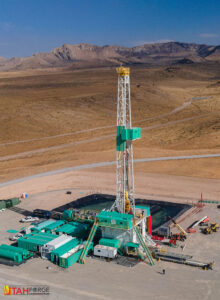
Utah FORGE’s mission is to develop, test, and accelerate breakthroughs in EGS to advance the uptake of geothermal resources around the world. In 2024, a multi-stage stimulation and an extended circulation were successfully conducted on the production and injection wells. Research conducted at Utah FORGE and across the world shows that EGS has the potential to permanently change the landscape for geothermal energy. For more information, turn to Utah FORGE’s “Data Dashboard” page at www.utahforge.com.

Conceptual model of the Utah FORGE project (source: Utah FORGE)
Innovation and advancement are expected to continue as substantial new projects in many countries (Kenya, the Philippines, Indonesia) are pushing geothermal energy farther into the mainstream of electricity production.
Cariaga, C. (2025). ThinkGeoEnergy’s Top 10 Geothermal Countries 2024 – Power. ThinkGeoEnergy. Published January 20, 2025. https://www.thinkgeoenergy.com/thinkgeoenergys-top-10-geothermal-countries-2024-power/
IEA (2024, Dec 13). Technology breakthroughs are unlocking geothermal energy’s vast potential in countries across the globe. International Energy Agency. https://www.iea.org/news/technology-breakthroughs-are-unlocking-geothermal-energys-vast-potential-in-countries-across-the-globe
Patel, Sonal (2023, Apr 4). EGS, AGS, and Supercritical Geothermal Systems: What’s the Difference? POWER. https://www.powermag.com/egs-ags-and-supercritical-geothermal-systems-whats-the-difference/
Reinsch, T., Dobson, P., Asanuma, H. et al. (2017). Utilizing supercritical geothermal systems: a review of past ventures and ongoing research activities. Geotherm Energy 5, 16. https://doi.org/10.1186/s40517-017-0075-y

The Energy & Geoscience Institute announces Dr. Kristie McLin as Director of Research and Science and new Principal Investigator of the Utah FORGE project, succeeding Dr. Joseph Moore.
The heat beneath our feet flows through the earth in a complex pattern. Utah FORGE is situated in a heat reservoir that has been studied since the 1970s. In this webinar, Dr. Stuart Simmons delves into the unique geologic and geothermal resources found at Utah FORGE and the surrounding area.
What exactly are the rock types that make up the underground laboratory of Utah FORGE? In this webinar, Dr. Clay Jones describes the geology of the site and surrounding area and the findings from core and cutting analyses of deep wells!