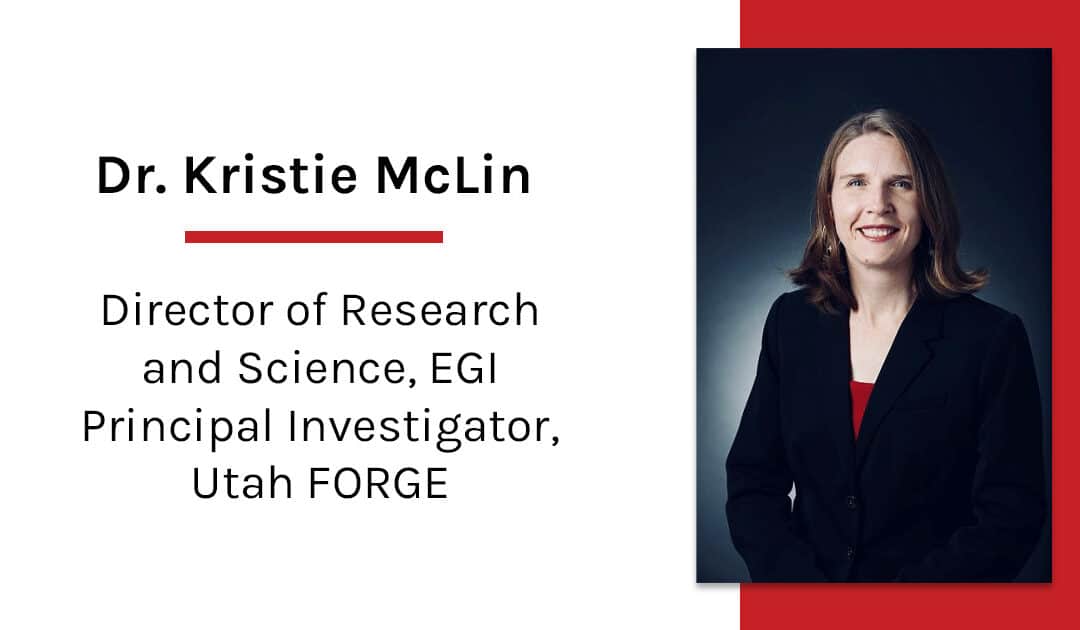
The Energy & Geoscience Institute announces Dr. Kristie McLin as Director of Research and Science and new Principal Investigator of the Utah FORGE project, succeeding Dr. Joseph Moore.

The University of Utah, in support of the Department of Energy’s (DOE), Energy Efficiency and Renewable Energy (EERE) Geothermal Technologies Office (GTO) Frontier Observatory for Research in Geothermal Energy (FORGE) offers solicitations for advancing Enhanced Geothermal Systems (EGS) technologies.
This endeavor aims to facilitate and spur transformative EGS research across the geothermal community, culminating in a set of rigorous and reproducible EGS technical solutions and a pathway to commercial EGS development.
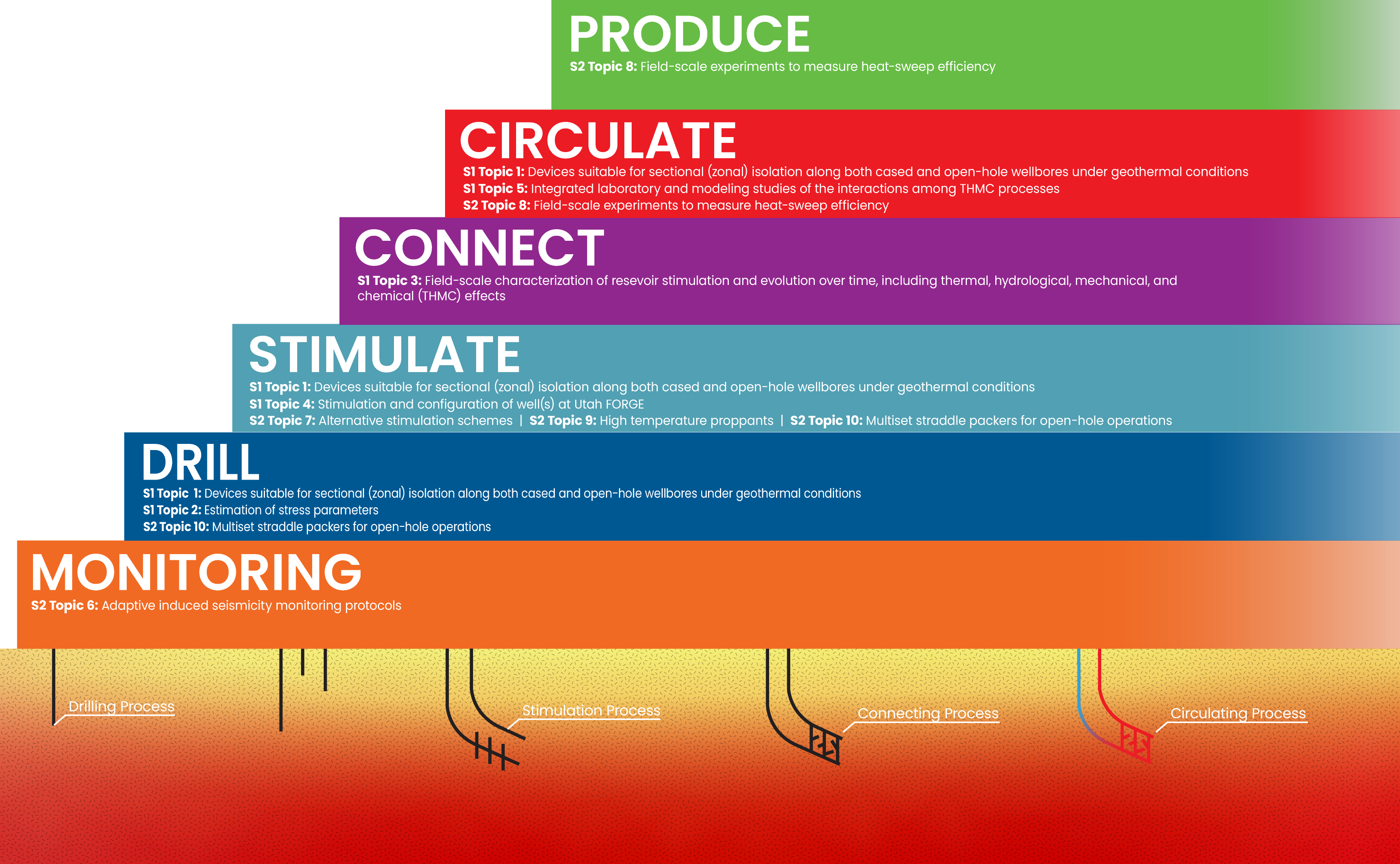
These solicitations cover testing and evaluation of new and innovative EGS tools, techniques, and supporting science in the following EGS lifecycle categories:
Reservoir characterization (coupled imaging, drilling for interrogation and monitoring, high-temperature tools and sensors)
Reservoir creation (formation access, fracture characterization, zonal isolation, stimulation technologies)
Reservoir sustainability (long-term testing, monitoring, and operational feedback)
*All eligible entities (including industry, universities, Federally Funded Research and Development Centers, non-profit organizations, government agencies, etc.) can submit proposals as individual entities or teams when solicitations are issued.
There are currently seventeen R&D projects that are participating in Utah FORGE. Check out data produced by each of the various research groups.
Congratulations to all 11 awardees. APPLICATIONS ARE NOW CLOSED.
Topic 6: Adaptive Induced Seismicity Monitoring Protocols
Awardee and their R&D project:
Topic 7: Alternative Stimulation Schemes
Awardee and their R&D project:
Topic 8: Field Scale Experiments to Measure Heat-Sweep Efficiency
Awardee and their R&D project:
Topic 9: High Temperature Proppants
Awardee and their R&D project:
Topic 10: Multiset Straddle Packers for Open Hole Operations
Search for other available data in the Geothermal Data Repository
Areas of interest include, but are not limited to:
Targets: Projects proposed under this Topic Area should consider the following and address how the proposed work can meet this target:
Field Constraints:
Areas of interest include, but are not limited to:
Targets: Projects proposed under this Topic Area should consider the following and address how the proposed work can meet this target:
Field Constraints:
Areas of interest include, but are not limited to:
Targets: Projects proposed under this Topic Area should consider the following and address how the proposed work can meet one or more of these targets:
Field Constraints:
Areas of interest:
Targets: Projects proposed under this Topic Area should consider the following and address how the proposed work can meet one or more of these targets:
Areas of interest include:
Targets: Projects proposed under this Topic Area should consider the following and address how the proposed work can meet these targets:
Field Constraints:
Methods and technologies that are feasible to implement and deemed safe for fielding at Utah FORGE or other locations. Location to be determined in consultation with Utah FORGE.
Find project details and history, as well as data produced by the Utah FORGE project, including but not limited to: key datasets and interpretations covering geoscientific characterization, well logs, reservoir stimulations, detection of microseismicity, and numerical simulations.

Congratulations to all 17 awardees. APPLICATIONS ARE NOW CLOSED.
Topic 1: Devices suitable for sectional (zonal) isolation along both cased and open-hole wellbores under geothermal conditions
Awardee and their R&D project:
Topic 2: Estimation of stress parameters
Awardee and their R&D project:
Topic 3: Field-scale characterization of reservoir stimulation and evolution over time, including thermal, hydrological, mechanical, and chemical (THMC) effects
Awardee and their R&D project:
Topic 4: Stimulation and configuration of the well(s) at Utah FORGE
Awardee and their R&D project:
Topic 5: Integrated Laboratory and Modeling studies of the interactions among THMC processes
Search for other available data in the Geothermal Data Repository
Areas of interest include, but are not limited to:
Targets: Projects proposed under this Topic Area should consider the following and address how the proposed work can meet one or more of these targets:
Existing Data Resources:
Areas of interest include, but are not limited to:
Targets: Projects proposed under this Topic Area should consider the following and address how the proposed work can meet one or more of these targets:
Existing Data Resources:
Areas of interest include, but are not limited to:
Targets: Projects proposed under this Topic Area should consider the following and address how the proposed work can meet one or more of these targets:
Field Constraints
Existing Data Resources:
Areas of interest:
The proposed stimulation designs should be optimized based on in situ reservoir data, including stress fields and pre-existing fractures, especially those that may cross lithological boundaries. The applicant will collaborate and coordinate with Utah FORGE closely during the deployment of the proposed stimulation approach. Furthermore, the applicant will be expected to share their analyses to the Utah FORGE team and collaborate on identifying the ideal placement and completion of the production well to provide optimal stimulated geometry and heat transfer to the circulating fluid.
Targets: Projects proposed under this Topic Area should consider the following and address how the proposed work can meet one or more of these targets:
Supporting modeling:
Existing Data Resources:
Areas of interest include, but are not limited to:
Targets: Projects proposed under this Topic Area should consider the following and address how the proposed work can meet one or more of these targets:
Existing Data Resources: