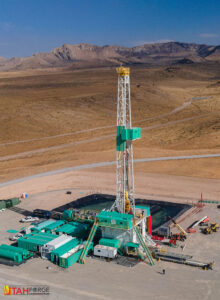
Utah FORGE project site landscape

Read the DOE GTO winners announcement.

The U.S. Department of Energy (DOE) Geothermal Technologies Office (GTO), in partnership with the Frontier Observatory for Research in Geothermal Energy (FORGE) and the Idaho National Laboratory (INL), invites both high school and university (undergraduate & graduate) teams to explore the future of geothermal energy and visualize the world of geothermal energy by participating in the 2019 Geothermal Design Challenge™.

Teams of 2 or 3 members will research data, interpret information and create a data visualization portfolio that will tell a compelling story about geothermal energy.


DID YOU KNOW…?

  • Energy sources originating from beneath the Earth’s surface satisfy over 80% of total U.S. energy needs.
  • Geothermal is one area of sub-surface energy that produces near–carbon free energy.
  • Geothermal has the smallest environmental footprint of all renewable energy sources.

Scenario

As a member of the FORGE project team you are tasked with siting a new geothermal well that will help researchers better understand man-made geothermal systems. Using the data provided, recommend an ideal subsurface location to create a sustainable subsurface heat exchanger. This critical step in FORGE’s site development will be the foundation of future R&D and operational efforts at the initiative.

Goal

Using the data provided , recommend a location within the FORGE footprint where we can create an enhanced geothermal reservoir with minimal environmental consequences. The location must be in granite (granitoid) and be between 175º and 225º Celsius.

  • Use a combination of at least five data sets to understand the site.
  • Use that understanding and the data to create 5–10 graphics to communicate your recommended location.

Challenge Question

Where do you target your next production well to maximize geothermal reservoir performance?

There are standard methodologies to site geothermal wells, such as geological interpretation and geospatial analysis. However, other methods may offer opportunities and promise, like advanced data analytics and machine learning. This data visualization challenge could reveal opportunities that haven’t been explored yet.

What is needed?

  • A portfolio of 5–10 data visualizations that support your recommended location.
  • A maximum 1-page write-up explaining your visualizations.

Guidelines

Each visualization should…

  • Support a single, consistent location of a new production well (location must be in granite (granitoid) and between 175º and 225º Celsius).
  • Incorporate at least two of the data sets.
  • Include data analysis as part of that incorporation.
  • Be visually appealing and clean.
  • Not be a direct output from a model or software package.

Each portfolio should…

  • Support a single location of a new production well (location must be in granite (granitoid) and between 175º and 225º Celsius).
  • Contain at least 5 unique visualizations and no more than 10 total.
  • Visually represent the data sets in the visualizations.
  • Have a cohesive visual theme.
  • Clearly communicate the location of your proposed well and why it should be there, using minimal text.
  • Include a maximum 1-page accompanying summary.

But I don’t know anything about geothermal energy or subsurface data…

We are looking for unique perspectives. In other words, your lack of experience with this data is actually a strength in this competition.

If you have any questions about the data or about geothermal energy and reservoirs, please reach out to the Challenge Team at Geothermalchallenge@inl.gov. In the meantime, take a look at the resources below!


Eligibility

High school (9–12) and university (both undergraduate and graduate) students (full or part-time) enrolled at an accredited U.S. academic institution at the time of submission are eligible to participate. Only U.S. citizens are eligible to participate in the 2019 Geothermal Design Challenge™.

Teaming

Students are asked to form teams of no more than three members. All members must be eligible to participate in the same bracket (high school or university). Students are encouraged to find a team mentor.

Registration

You must register your team at Skild . Skild coordinates submissions and communication throughout the competition.

Software

Teams can use any data visualization software they choose, or a variety of software (public or private license). Examples include:

  • Tableau
  • ArcGIS
  • Python
  • SAS
  • R
  • Excel
  • Octave
  • Earth Model Packages (e.g. Leapfrog, Petrel, Jewel Suite, etc.)

You are not limited to only the above software examples.

Timeline

  • Registration begins: January 7, 2019 (8 am ET)
  • Portfolios due: April 10, 2019 (10 pm ET)
  • Winners announced: April 24, 2019

Prizes

The top 3 winning teams will be awarded as follows:

  • 1st place team: $5,000
  • 2nd place team: $3,500
  • 3rd place team: $2,500

Review Criteria

Teams will be judged based on the following criteria:

  • Creativity and innovation – Unique product, compelling to a broad audience, impact; for example, using standard geothermal data sets in non-traditional ways or using non-standard data sets in any type of analysis (25%).
  • Analytical depth – Logical, clear analysis with a range of complexity; for example, using multivariate analysis or machine learning methods; geological reasonableness including what and how many features were used to select the location (25%).
  • Design – Aesthetics and suitable design elements (25%).
  • Communication – Clear story, answers the challenge theme; effective use of visualizations with minimal text; clear narrative to supplement visualizations (25%).

What is FORGE?

FORGE's mission is to enable cutting-edge research, drilling, and technology testing, as well as to allow scientists to identify a replicable, commercial pathway to EGS. In addition to the site itself, the FORGE effort includes robust instrumentation, data collection, and data dissemination to capture and share data and activities occurring at FORGE in real time. The innovative research, coupled with an equally innovative collaboration and management platform, is truly a first-of-its-kind endeavor.

R&D Activities

All R&D activities at FORGE focus on strengthening our understanding of the key mechanisms controlling EGS success—specifically, how to initiate and sustain fracture networks in basement rock formations. This critical knowledge will be used to design and test a methodology for developing large-scale, economically sustainable heat exchange systems, paving the way for a rigorous and reproducible approach that will reduce industry development risk and facilitate EGS commercialization.

R&D activities may include, but are not limited to, innovative drilling techniques, reservoir stimulation techniques, and well connectivity and flow-testing efforts. The site will also require continuous monitoring of geophysical and geochemical signals.

Additionally, dynamic reservoir models will play an integral role in FORGE by allowing the site operator to synthesize, predict, and verify reservoir properties and performance. R&D activities will have open participation via competitive solicitations to the broader scientific and engineering community.

As advancements in EGS are made over the course of FORGE's operation, R&D priorities are likely to shift in response. FORGE is designed to be a dynamic, flexible effort that can adjust to and accommodate the newest and most compelling challenges in the energy frontier.

Learn More

Resources

Guides

Webinars

Geothermal

Data Visualization

2019 Geothermal Design Challenge™ Questions & Answers

Do you have a question about the Geothermal Design Challenge™?
Send your question to Geothermalchallenge@inl.gov. Questions and answers will be posted below.

Do all team members need to be U.S. citizens, or is one citizen per team enough?

Answer: All team participants (registrants) must be U.S. citizens in order for the team to be eligible.

How should we use the 58-32 well logs to help optimize our site selection?

Answer: Borehole geophysics and log interpretation is a highly specialized field, and it can take considerable experience to fully interpret these data. Given the broad nature of your question, we cannot provide detailed guidance without effectively mentoring you, which would compromise our impartiality. We recommend reaching out to a faculty member or teacher who can advise you directly.

In well_location_from_earth_model.csv, is “z (land surface)” the well elevation?

Answer: Yes. The “z (land surface)” column gives the elevation of the well top with respect to sea level.

In well_based_temperature.csv, why are some “z” values negative?

Answer: The spatial data indicate where the temperature was estimated or measured. “z” represents elevation, not depth, so it can be positive or negative depending on the reference level.

How could the core photographs be useful?

Answer: Even with only core photographs, you can look for fractures, grain size and type, and overall rock character. Core photos can also help corroborate interpretations from geophysical well logs.

When you say “next location,” do you mean an injection–production pair?

Answer: We intentionally left this somewhat open so participants can be creative and take their projects as far as they wish. You do not have to propose a full injector–producer pair, but thinking through such a pair would be a valuable learning exercise and will not count against you in judging.

Will the wells be horizontal?

Answer: They could be, but it is up to you to make and justify that recommendation.

Do the wellbores need to be hydraulically connected?

Answer: Yes. There must be a hydraulic connection between wellbores that can provide sustained recovery of heat from the rocks.

Is the injection well the only well that will be stimulated (fracked)?

Answer: Not necessarily. The injection well will definitely be stimulated, but other wells may be as well, depending on your design.

Do we need to decide the spacing between injection and production wells?

Answer: Yes. You should recommend the distance between wells as part of your proposed design.

Are there examples of projects from previous years?

Answer: This is the first year we are running a data visualization contest, so we do not have prior examples. Please refer to the reference materials in the “Resources” section of the website: https://utahforge.com/studentcomp/ .

Does a mentor need to be part of FORGE, or can they be a teacher or scientist elsewhere?

Answer: Teams are encouraged to use a mentor, but mentors do not need to be part of the FORGE team. Your mentor can be any person you consider appropriate to help with your project.

To what depths is the FORGE research team willing to drill to reach the target temperature?

Answer: Temperature isotherms were provided for 175–225 °C. In general, we plan to remain within the depths corresponding to those temperatures.

Is Colorado within the FORGE footprint?

Answer: No. The FORGE site is in Utah, not Colorado.

Where can we find similar competitions or projects?

Answer: This is the first project of this kind sponsored by the Geothermal Technologies Office. You can find other competitions sponsored by the Department of Energy’s Office of Energy Efficiency & Renewable Energy at: https://www.energy.gov/eere/education/competitions .

In the well survey data, what is the difference between dip and azimuth?

Answer: The “dip” is the deviation of the well path from vertical. A dip of 90° means the well is vertical; a dip of 0° means the well is horizontal. The azimuth is the compass direction (0–360°, clockwise) in which the well is dipping. For example, a horizontal well going east would have a dip of 0° and an azimuth of 90°. For more information, see: Leapfrog desurveying options .

Are the fault and temperature surface coordinates in meters or feet, and why do some features appear above ground?

Answer: Faults can extend above the ground surface and can be cropped to the surface as needed. All x, y, and z values are in meters. The FORGE outline shapefile is set to an arbitrary elevation; the important information is the x–y position.

I’m an undergraduate at the University of Utah and work with EGI. Am I still eligible?

Answer: Yes, you are eligible to participate in the 2019 Geothermal Design Challenge™. However, please do not contact EGI staff with questions. All questions must be sent to Geothermalchallenge@inl.gov for consideration.

Do we need to consider financial and legal constraints in our proposed well site?

Answer: For the most part, focus on the technical aspects and the “art of the possible” — be creative. If you propose something very unusual, it may be helpful to include brief information on feasibility (e.g., cost or permitting), but it is not the primary focus.

Should we account for current well conditions (casing, grouting, etc.), or assume wells are usable?

Answer: You may assume the current test well (58-32), and any other well you propose, are fully usable within standard industry pressures expected during stimulation activities.

Is there any well connectivity or tracer data available?

Answer: No. We have not conducted tracer tests yet. Some tests are planned, but they will take place after the contest concludes.

What EGS stimulation conditions (fracture length and density) should we assume?

Answer: That is for you to decide. “Reasonable” is relative and should be justified by your analysis and arguments. You should explain why your assumptions and outcomes are reasonable.

How can we create visualizations with software if they cannot be a direct model output?

Answer: We are looking for more than a single bar chart or line graph. Use software to build a dashboard or portfolio of visualizations that tell a cohesive story. A good source of examples is the Tableau Public Gallery: https://public.tableau.com/en-us/s/gallery . For instance, Boeing’s global market outlook uses several coordinated visualizations to tell a story: Boeing Current Market Outlook .

Can we use a mentor, and do they need to register?

Answer: Yes. Having a team mentor is encouraged. Mentors do not need to register for the competition.

Are we limited to the student data sets, or can we use other data sources?

Answer: You may use other publicly available data, but you must cite all outside data in your submission. Remember that the challenge focuses on siting a new well at the FORGE site in Milford, Utah. Please send any additional data links you plan to use to Geothermalchallenge@inl.gov so we can verify their accuracy.

Can we use published articles about the FORGE site?

Answer: Yes. You are encouraged to find and use published articles about FORGE.

Where can I find the legend for the geologic map and rock unit descriptions?

Answer: You can find the full geologic map and legend here: https://gdr.openei.org/submissions/1034 .

Can we use Unity or Three.js to build our visualizations?

Answer: Yes. Unity and Three.js are open-source frameworks and you are free to use them. We have not developed special visualization libraries for this competition in either framework, so you will be building from standard tools. Just be sure your final visualizations follow the competition guidelines: https://utahforge.com/studentcomp/ .

Are we restricted to the data provided for the challenge?

Answer: You may use other publicly available data, but you must cite any external sources. The focus of the challenge remains siting a new well at the FORGE site in Milford, Utah.

Can students at universities outside the United States participate?

Answer: Students are eligible if they are U.S. citizens and are attending accredited U.S. universities at the time of the competition.